Description
No. The grey/charcoal 804 stainless steel rods on our heating elements are stronger, lighter, more corrosion resistant and about 8 times more expensive to manufacture than standard 304/316 stainless steel (see previous questions for more details). Many of the shiny 304/316 stainless steel elements that are sold are also not ULWD and not UL listed.
While we love and use shiny 304/316 stainless in our brewery on just about every other surface, this is one place where we chose to use the best product for the job: Grey/Charcoal coloured 804 stainless steel heating elements.
A typical no name Chinese heating element made from softer 304/316 stainless that is also not ULWD and not UL listed:
Our heating elements use the same resilient nickel-chromium stainless steel alloy sheath as the popular 02963 model that brewers have been using for years. The 02963 shown in the picture below has been in use for over 5 years and still looks like new:
I want to replace my old elements with these ones but the nut inside the kettle seems rusted to the element. How do I remove it?
See our instructions: Replacing heating elements.
What sort of plugs are included with your heating elements?
The heating element cords come equipped with an industrial grade NEMA L6-30 (250VAC, 30A) twist lock electrical male plug to prevent accidental disconnection. We do not use cheap molded rubber plugs.
How long are the power cords? What are they made of?
Standard cord length is 10 feet, with 12, 15, 20 also available. Contact us for custom lengths.
We use premium SJEOOW cords that feature a thermoplastic elastomer jacket which means that the cable remains more flexible than standard (less expensive) cords. Rated to 300 volts and from -50 to 105 degrees Celsius. These cords are designed for use in harsh environments where the highest degree for oil/water/weather resistance and extended service life are essential. The cord is further protected with expandable sleeving.
What voltage do these heating elements work at? How many phases?
In order to produce the stated 4500W or 5500W power output, the heating elements require 240V AC, single phase.
They may also be run at lower voltage but the power output and current draw will be reduced. For example, running these heating elements at 120V produces one quarter of the rated power output at half the current draw. A 5500W element may therefore be powered from a standard 15 amp / 120V circuit to produce 1375W drawing 11.5 amps, whilea4500W element running off a 15 amp / 120V circuit would produce 1125W drawing 9.375 amps.
You may also use a single phase of a 208V or 400V 3-phase system: On most 3-phase 208V power systems 208V is available between any two of the phases (HOT lines) while on most 3-phase 400V power systems 230V is available between any of the phases (HOT lines) and NEUTRAL. At 208V, the 5500W produces 4133W and at 230V it produces 5053W.
Where can these heating elements be used?
Our heating elements may be used anywhere in the world. See previous question.
What’s included with the pre-assembled heating elements?
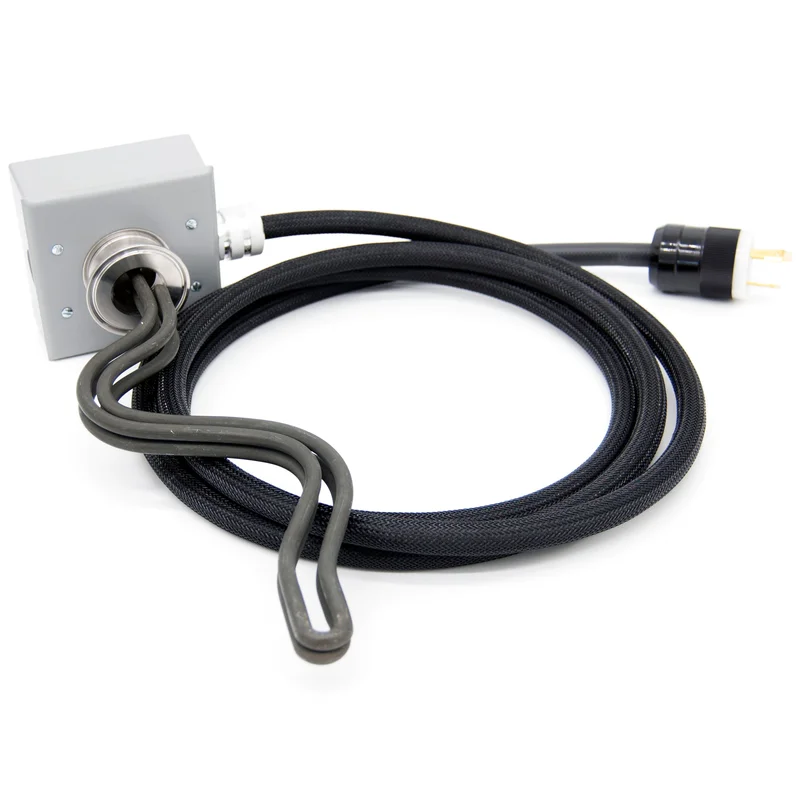
With the pre-assembled heating elements we’ve done all the work for you, including welding, punching, priming, and painting the boxes and hooking up all of the electrical connections. The mounting washer, nut, and o-ring is included if you wish to install directly in a kettle wall. The food grade silicone adhesive/sealant is also included. All you need to supply is the kettle.
How does this heating element assembly compare to the Blichmann Boil Coil?
See this forum thread for our thoughts on the Boil Coil.
How low can I install the heating element assembly?
To allow enough for room on the outside of the kettle for the outlet box, the hole in the kettle needs to be at last 2-3/8″ from the base of the kettle.
My kettle doesn’t have any holes or fittings for elements. How do I attach the heating element assembly?
The heating element assembly comes with parts to form a tight weldless fitting. Simply Punch a 1-1/4″ hole in your kettle, and then secure the heating element assembly using the included washer, nut, o-ring, and seal on the inside of the box between the heating element and box cover with the food grade silicone adhesive/sealant (also included).
My kettle has a 1″ NPS welded fitting for an element. How do I attach the heating element assembly?
Simply screw the element and box on to the fitting. Make sure to use PTFE white / Teflon tape on the element threads to ensure a tight, leak-free fit (see this video) and seal on the inside of the box between the heating element and box cover with the food grade silicone adhesive/sealant (included). See our secure the heating element assembly instructions for a picture. The washer, nut, and o-ring supplied with your DIY kit are not used.
My kettle has a Tri-Clamp (sometimes called Tri-Clover) fitting for an element. How do I attach the heating element assembly?
Specify your Tri-Clamp size (either 1.5″ or 2″) when ordering and we’ll include a pre-fitted adapter already screwed on the element threads. To fasten the element to the kettle use a Tri-Clamp clamp and gasket (not included) as you would normally and seal on the inside of the box between the heating element and box cover with the food grade silicone adhesive/sealant (included). The washer, nut, and o-ring are not used. Please note that we can only guarantee fit with our tri-clamp adapters. Tri-Clamp adapters sold by others may not fit.
I want to build my own heating element assembly. What’s included in the DIY kit?
See our Electric Brewery heating element assembly (DIY Kit) page.
I’m using a different heating element. Why is the base rusting?
If using a different brand of element or the popular Camco 02963 model, the threaded silver coloured base of the heating element is not corrosion resistant and some rust may form on this base if water is left in the kettle for a prolonged period of time. These other heating elements are normally used in electric water heaters that also have a sacrificial anode installed to combat this issue. The anode’s sole purpose is to oxidize first, thereby protecting the heating element base from rusting. Brewing kettles do not have an anode so make sure you do not leave water in the kettle for a prolonged period of time if using a heating element not specifically designed for brewing. This may be exacerbated if you have hard water. Some brewers will install a magnesium anode in the side of their kettle to combat this issue when using a different type of heating element. See this forum thread for some example installations and instructions.
Visit our official Heating Element Assemblies product thread in our forum.
Reviews
There are no reviews yet.